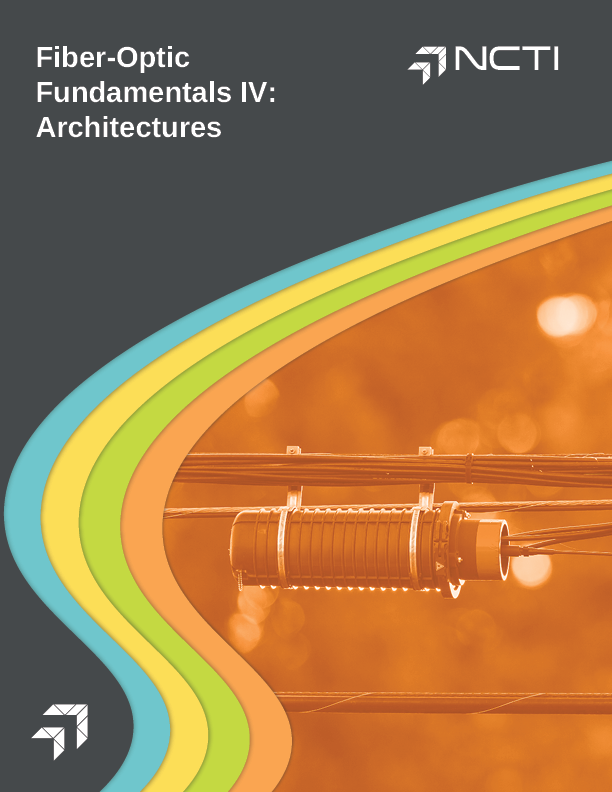
The NCTI® Fiber-Optic Fundamentals IV: Architectures course explores the critical components of fiber-optic networks, including passive optical networks (PON), and emerging technologies shaping the future of fiber communications. As fiber-optic networks continue to evolve, understanding network elements, topologies, and next-generation technologies is essential for ensuring efficient deployment and long-term scalability.
Fiber networks rely on key elements such as optical line terminals (OLT), optical network units (ONU), splitters, amplifiers, and wavelength division multiplexers. Understanding these elements is crucial for installation and maintenance. Technicians must understand how different network topologies affect performance, redundancy, and scalability. With the growing adoption of PON architectures, including GPON, XGS-PON, and NG-PON2, technicians must also grasp how these technologies enable high-speed broadband delivery.
In this course, students will learn the structure of fiber-optic networks, the role of essential components, how PON technology enables efficient, high-speed data transmission, and the principles of next-generation technologies. By the end, they will be equipped to work with various network architectures, understand their applications, and prepare for advancements in fiber-optic communication.