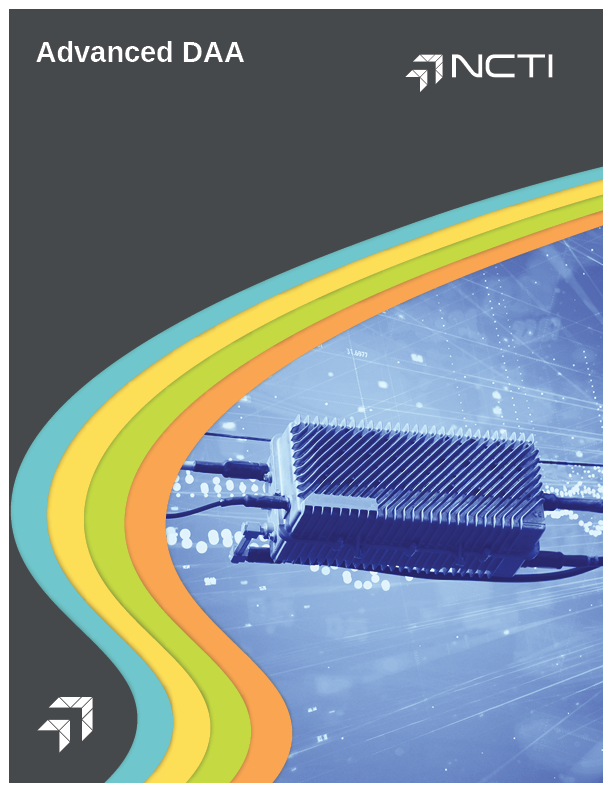
Advanced DAA

Course Overview

Distributed Access Architecture (DAA) is transforming how broadband networks are designed, deployed, and operated. As Data Over Cable Service Interface Specification (DOCSIS) functions move closer to the edge and network operations become increasingly virtualized and software-driven, broadband professionals need to understand not only how DAA architectures work but also how the technologies behind them integrate.
 
The NCTI® Advanced DAA course explores the evolution of distributed architectures, from Remote PHY and Remote MACPHY to virtual CMTS platforms and the networks that connect them. The course examines remote access devices (RAD), Converged Interconnect Networks (CIN), Ethernet transport, timing and synchronization, and the infrastructure considerations that shape real-world DAA deployments. It also examines how virtualization, software-defined networking (SDN), orchestration, automation, telemetry, predictive maintenance, and AI-assisted operations are changing broadband network management.
By connecting architectural and transport concepts with deployment and operational considerations, this course helps students learn how modern DAA networks enable greater scalability, resiliency, and operational flexibility while preparing broadband networks for DOCSIS 4.0 and future technologies. Though not required, a basic background in or understanding of DAA may be helpful.

The estimated completion time for this course is 2 hours. The maximum allotted time is four months from enrollment.

Explain the evolution of DAA from centralized CMTS platforms to R-PHY and R-MACPHY, and explain the role of virtual CMTS platforms in supporting distributed deployments.

Compare R-PHY and R-MACPHY architectures and deployment models based on the distribution of DOCSIS processing functions and the use of centralized processing within a DAA environment.

Explain the role and physical deployment requirements of remote access devices (RAD), including how standardized platforms such as GAP support DAA implementations.

Evaluate the network's physical and operational requirements that influence DAA selection, deployment planning, and ongoing support.

Explain the purpose and architecture of the CIN within a DAA deployment, including Ethernet transport, spine-leaf architecture, and network resiliency characteristics.

Describe how key transport technologies support CIN operation, including Ethernet encapsulation, DWDM for increased capacity, and QoS for traffic prioritization.

Explain how PTP provides the precise timing and synchronization required for R-PHY operation within a DAA deployment.

Explain how vCMTS supports DAA deployments through software-based DOCSIS processing and by distributing MAC and PHY functions in R-PHY and R-MACPHY architectures.

Describe how VNFs and SDN improve DAA deployments, including centralized policy management and more flexible network operations.

Evaluate the infrastructure's operational and management considerations associated with deploying vCMTS, VNFs, and SDN within a DAA network.

Explain how orchestration, automation, and configuration management support efficient and consistent DAA network operations, including automated provisioning and predefined operational tasks.

Describe software lifecycle management in DAA networks, including software deployment, change management, rollback processes, and methods for reducing operational risk.
receive an industry-recognized NCTI certificate of graduation

Related courses

NCTI-Cover-Empty
NCTI-Cover-Empty
NCTI-Cover-Empty
NCTI-Cover-Empty
NCTI-Cover-Empty
NCTI-Cover-Empty
NCTI-Cover-Empty
NCTI-Cover-Empty
NCTI-Cover-Empty
Share this page: