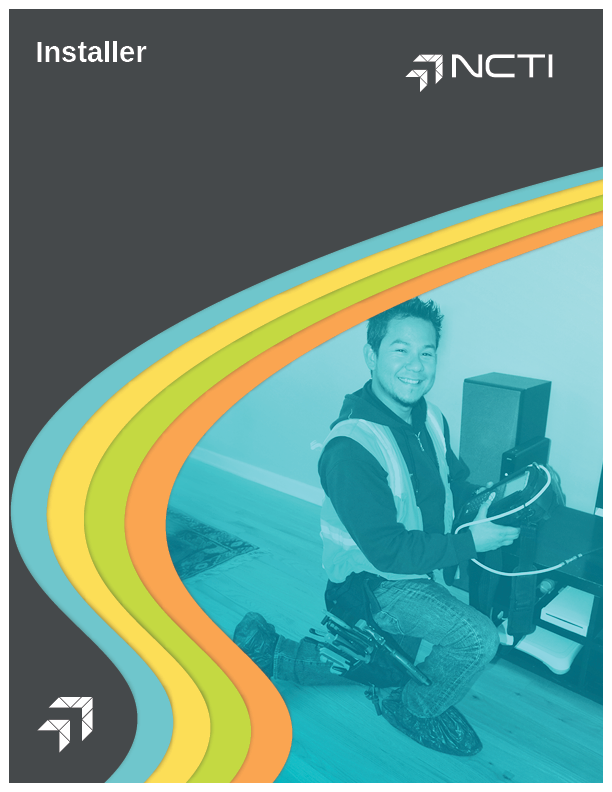
Installer
Course Overview
The NCTI® Installer course is the foundation for NCTI’s Technical Career Path, as well as an essential preparation for the Broadband Digital Installer and Installer Technician courses. It provides a comprehensive introduction to residential broadband installation, blending technical foundations with practical field skills and customer-focused practices. Students progress from understanding broadband network architectures, signal transmission, and Wi-Fi fundamentals to mastering the tools, safety procedures, and installation and troubleshooting techniques required for coaxial, fiber-optic, and twisted-pair systems.
The course also emphasizes professional customer interactions, safe vehicle and aerial operations, efficient work practices, high-quality interior and exterior craftsmanship, and systematic troubleshooting methodologies. By the end of the course, students are prepared to install, configure, and support modern residential broadband and Wi-Fi services with confidence and consistency.

- Price: $715.00
- Seat time: 32h
- Course number: eb0115_08_JN
- Dynamic language translation available
- Category: Technical and Safety
The estimated completion time for this course is 30 hours. The maximum allotted time is four months from enrollment.
Course Objectives
Analyze broadband network architectures and signal flow by distinguishing between radio frequency and digital signal principles used in residential broadband systems.
Demonstrate effective customer service by applying professional communication techniques, managing stress, and evaluating customer interactions.
Select and correctly use coaxial, twisted-pair, and fiber-optic testing tools for standard installation and verification tasks.
Perform routine vehicle inspections and apply safety procedures to operate service vehicles and bucket trucks in compliance with safety standards.
Apply safe installation practices by selecting appropriate PPE and using electrical detection and fiber safety procedures to mitigate job-site hazards.
Execute aerial plant access procedures by safely operating ladders and performing pole-climbing tasks using approved methods.
Differentiate transmission mediums by evaluating the characteristics and use cases of coaxial, fiber-optic, and twisted-pair drop cables.
Install and configure transmission components by integrating coaxial, fiber-optic, MoCA, and twisted-pair premises equipment into a residential network.
Apply interior craftsmanship techniques by planning cable routes, performing wall entries, and completing wallfishing tasks that preserve structural integrity and aesthetics.
Apply exterior craftsmanship techniques by installing underground and aerial drop cables and implementing proper bonding and grounding practices.
Install residential fiber drops by preparing the site, installing fiber drops, and completing splicing tasks in accordance with installation standards.
Configure in-home wiring systems by installing fiber, terminating twisted-pair cabling, and validating data signal transmission at RJ45 outlets.
Analyze Wi-Fi system fundamentals by applying RF concepts, interpreting 802.11 standards, and evaluating router, antenna, and security configurations.
Design and implement a residential Wi-Fi installation by optimizing equipment placement, configuring security settings, and deploying mesh or managed Wi-Fi solutions.
Apply systematic troubleshooting methods and appropriate testing tools to diagnose, measure, and resolve broadband and in-home network signal issues while improving overall performance and reliability.

Demonstrate effective customer service by applying professional communication techniques, managing stress, and evaluating customer interactions.
Select and correctly use coaxial, twisted-pair, and fiber-optic testing tools for standard installation and verification tasks.
Perform routine vehicle inspections and apply safety procedures to operate service vehicles and bucket trucks in compliance with safety standards.
Apply safe installation practices by selecting appropriate PPE and using electrical detection and fiber safety procedures to mitigate job-site hazards.
Execute aerial plant access procedures by safely operating ladders and performing pole-climbing tasks using approved methods.
Differentiate transmission mediums by evaluating the characteristics and use cases of coaxial, fiber-optic, and twisted-pair drop cables.
Install and configure transmission components by integrating coaxial, fiber-optic, MoCA, and twisted-pair premises equipment into a residential network.
Apply interior craftsmanship techniques by planning cable routes, performing wall entries, and completing wallfishing tasks that preserve structural integrity and aesthetics.
Apply exterior craftsmanship techniques by installing underground and aerial drop cables and implementing proper bonding and grounding practices.
Install residential fiber drops by preparing the site, installing fiber drops, and completing splicing tasks in accordance with installation standards.
Configure in-home wiring systems by installing fiber, terminating twisted-pair cabling, and validating data signal transmission at RJ45 outlets.
Analyze Wi-Fi system fundamentals by applying RF concepts, interpreting 802.11 standards, and evaluating router, antenna, and security configurations.
Design and implement a residential Wi-Fi installation by optimizing equipment placement, configuring security settings, and deploying mesh or managed Wi-Fi solutions.
Apply systematic troubleshooting methods and appropriate testing tools to diagnose, measure, and resolve broadband and in-home network signal issues while improving overall performance and reliability.
Course Benefits
receive an industry-recognized NCTI certificate of graduation
earn three hours of college credit
help prepare for SCTE’s Broadband Premises Installer certification
receive credit toward the NCTI Master Technician certification
receive credit toward the NCTI Master Installer certification
earn three hours of college credit
help prepare for SCTE’s Broadband Premises Installer certification
receive credit toward the NCTI Master Technician certification
receive credit toward the NCTI Master Installer certification
Share this page: