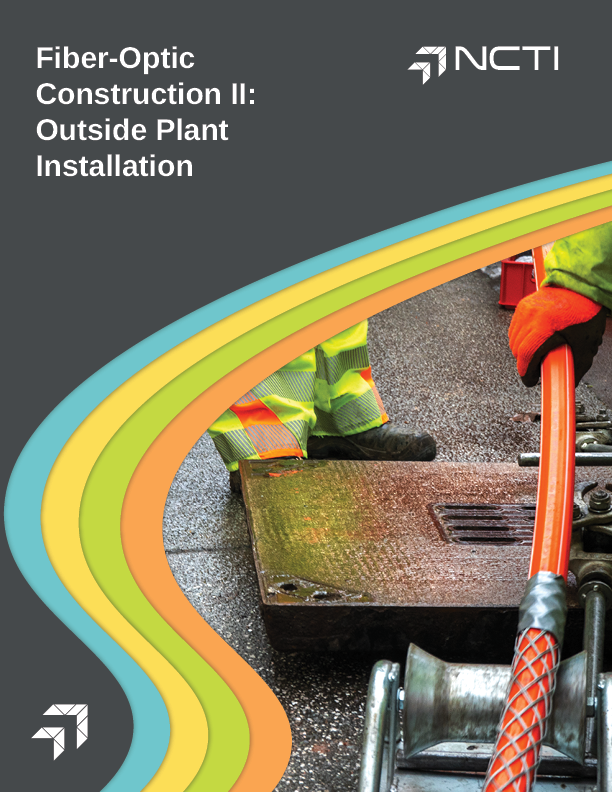
Fiber-Optic Construction II: Outside Plant Installation
Course Overview
The NCTI® Fiber-Optic Construction II: Outside Plant Installation course builds upon foundational knowledge to prepare learners for the safe and effective installation of fiber-optic cable in underground environments. It provides comprehensive training in the methods and safety practices essential for underground fiber-optic cable installation, emphasizing safe excavation procedures, regulatory compliance, and the effective use of specialized equipment, including plows, trenchers, boring machines, and vacuum excavation systems.
Participants gain knowledge in identifying underground hazards, interpreting utility markings, applying personal protective equipment (PPE), and managing traffic control in construction zones. The curriculum explores key installation techniques, including plowing, trenching, horizontal directional drilling, and conduit-based cable placement. It also addresses backfilling, compaction, site restoration, and slack cable storage to ensure durable and professional results. This course prepares learners to perform underground installations that meet industry standards for safety, reliability, and performance.

- Price: $640.00
- Seat time: 8h
- Course number: eb0691_01_JN
- Dynamic language translation available
- Category: Technical and Safety
The estimated completion time for this course is 8 hours. The maximum allotted time is four months from enrollment.
Course Objectives
Identify and mitigate hazards in underground fiber-optic operations, including trenching and directional drilling activities.
Apply federal and state safety codes, regulations, and best practices relevant to underground construction and utility location.
Interpret utility markings and demonstrate safe excavation practices to prevent damage to existing infrastructure.

Select and use appropriate personal protective equipment (PPE) and follow traffic control, channelization, and flagging procedures to maintain worksite safety.
Identify and explain the types, functions, and applications of static and vibratory plows used for underground fiber-optic cable installation.
Demonstrate safe and effective methods for operating plows and trenchers, including equipment components, control setups, and accessories.
Apply proper trenching techniques using chain trenchers, including excavation angles, trench types, and safe navigation in varied environments.
Perform post-installation tasks such as backfilling, soil compaction, sod and landscaping restoration, and site cleanup to maintain safety and trench integrity.
Demonstrate safe and effective procedures for dry and fluid-assisted boring operations, including equipment types, setup, pilot hole drilling, and site restoration.
Explain the principles, advantages, and safety protocols of hydro-vac and vacuum excavation methods, especially when working near buried utilities.
Explain industry practices and codes for grounding, bonding, and high air speed blowing to ensure safe and efficient fiber-optic cable installation.
Apply federal and state safety codes, regulations, and best practices relevant to underground construction and utility location.
Interpret utility markings and demonstrate safe excavation practices to prevent damage to existing infrastructure.
Select and use appropriate personal protective equipment (PPE) and follow traffic control, channelization, and flagging procedures to maintain worksite safety.

Identify and explain the types, functions, and applications of static and vibratory plows used for underground fiber-optic cable installation.
Demonstrate safe and effective methods for operating plows and trenchers, including equipment components, control setups, and accessories.
Apply proper trenching techniques using chain trenchers, including excavation angles, trench types, and safe navigation in varied environments.
Perform post-installation tasks such as backfilling, soil compaction, sod and landscaping restoration, and site cleanup to maintain safety and trench integrity.
Demonstrate safe and effective procedures for dry and fluid-assisted boring operations, including equipment types, setup, pilot hole drilling, and site restoration.
Explain the principles, advantages, and safety protocols of hydro-vac and vacuum excavation methods, especially when working near buried utilities.
Explain industry practices and codes for grounding, bonding, and high air speed blowing to ensure safe and efficient fiber-optic cable installation.
Course Benefits
receive an industry-recognized NCTI certificate of graduation
Share this page: