Fiber-Optic Installation II: Residential Installation

Course Overview

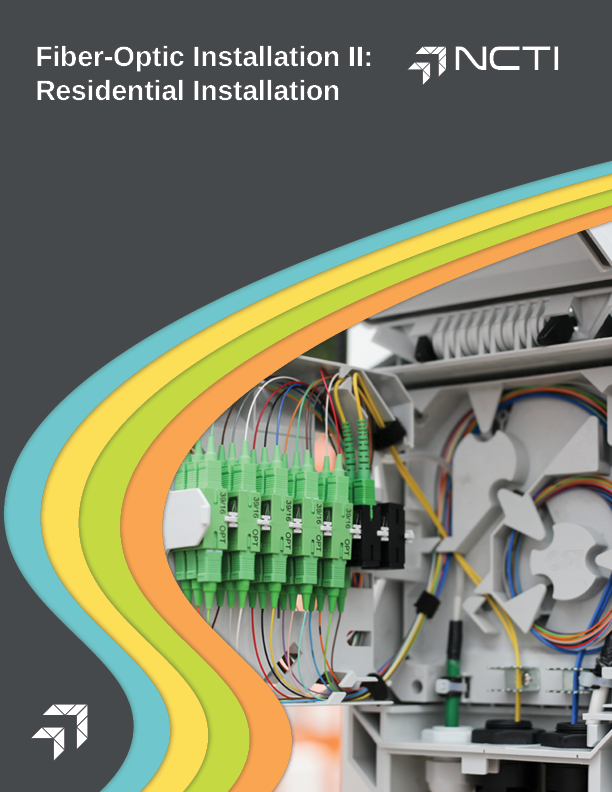
Welcome to the NCTI® Fiber-Optic Installation II: Residential Installation course, a comprehensive course designed to prepare you for one of the most in-demand roles in today's broadband industry. As fiber replaces older technologies in homes nationwide, skilled technicians are essential to ensure fast, reliable service from the curb to the living room. This course gives you the practical knowledge and troubleshooting skills needed to install fiber-optic systems correctly and diagnose and resolve issues that impact performance.
 
This course begins with a strong foundation in safety, covering the proper use of personal protective equipment (PPE), awareness of electrical hazards, and the importance of bonding and grounding fiber-optic components. Technicians will gain an in-depth understanding of residential fiber infrastructure, from the outside plant (OSP) to in-home equipment, including drop cables, access terminals, fiber demarcation boxes, optical network terminals (ONT), and fiber outlets.
 
The course covers fiber handling, splicing, connector selection (such as UPC and APC types), and termination. Students will also learn how to identify and use key installation and signal testing tools to ensure high-performance service delivery and how to identify and resolve common problems such as signal loss, poor terminations, physical damage, and configuration errors. Upon completion, students can carry out high-quality residential fiber installations and troubleshoot issues confidently, ensuring reliable service and customer satisfaction in a fiber-connected world.

The estimated completion time for this course is 8 hours. The maximum allotted time is four months from enrollment.

Explain residential fiber infrastructure from the OSP to the customer premises, including access terminals, fiber demarcation boxes, ONUs, and ONTs.

Describe fiber-optic cable, functions, and related parts used in installations, including the differences between loose tube and tight-buffered cables.

Explain key installation considerations for fiber-optic drops, including NID placement, aerial clearances, direct burial methods, and the use of conduit.

Describe the preparation, termination, bonding, and grounding of fiber-optic drop cables, including differences between pre-terminated and field-terminated options.

Explain how to prepare, splice, and store optical fibers, including sizing, trimming, cleaning, and using slack trays and splice holders.

Explain how to install fiber-optic outlets, including the differences between pre-wired and post-wired setups, the necessary materials, and how to select appropriate connector types such as UPC and APC.

Explain the structure, types, and identification of twisted-pair cables, including color coding, insulation, UTP vs. STP differences, Ethernet categories, and their applications.

Explain the standards, identification, termination, and testing of RJ45 connections, including the difference between RJ45 and 8P8C, ANSI/TIA wiring schemes, and required tools.

Explain how keystone jacks, patch panels, and home networking components, including wiring, connectors, and devices, affect data transfer speeds from the ONU/ONT to the end user.
earn two hours of college credit

receive credit toward NCTI Master Technician certification

receive an industry-recognized NCTI certificate of graduation

Related courses

NCTI-Cover-Empty
NCTI-Cover-Empty
NCTI-Cover-Empty
NCTI-Cover-Empty
NCTI-Cover-Empty
NCTI-Cover-Empty
NCTI-Cover-Empty
NCTI-Cover-Empty
NCTI-Cover-Empty
Share this page: