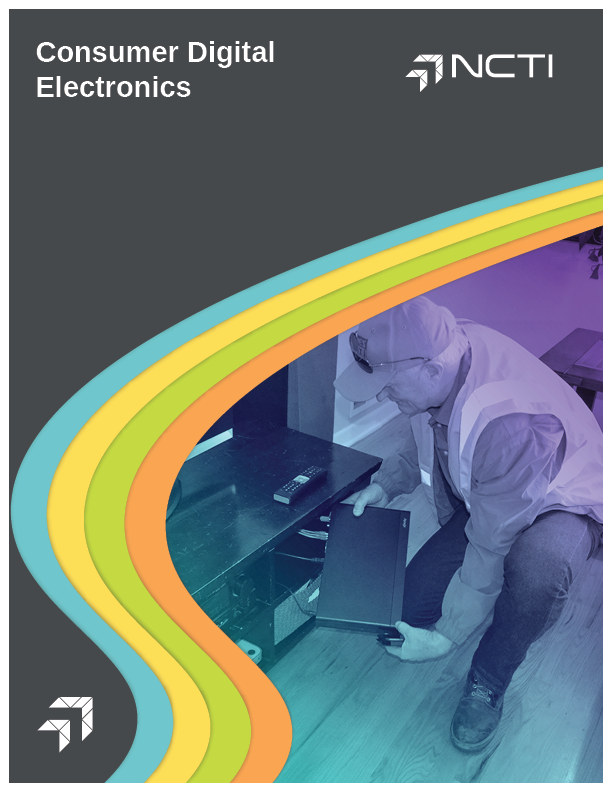
Consumer Digital Electronics

Course Overview

In a world that continues to heavily rely on smart TVs, computers, smartphones, gaming systems, streaming devices, security cameras, and other connected equipment for entertainment, communication, work, education, and everyday services, broadband professionals face increasing challenges. Wi-Fi standards, streaming formats, smart-home ecosystems, gaming platforms, and Internet of Things (IoT) products evolve much faster than traditional network infrastructure.

The NCTI® Consumer Digital Electronics (CDE) course explores the devices and ecosystems commonly connected to broadband networks, as well as the technologies that enable those devices to communicate. It examines device connectivity, home networking, audio and video technologies, smart and connected devices, and other factors that influence performance.

The goal is not to memorize every device or manufacturer. Consumer technology changes too quickly for that approach to remain useful. Instead, the focus is on principles that apply across devices and technologies, empowering students to adapt easily.

By understanding how consumer electronics connect, communicate, and use broadband services, telecommunications professionals can troubleshoot more effectively, explain performance issues more clearly, and feel confident in supporting the connected experiences customers depend on every day.

The estimated completion time for this course is 16 hours. The maximum allotted time is four months from enrollment.
Describe how wireless connectivity and smart home devices have changed home network requirements and device dependence on the network.

Explain how device bandwidth demands and wireless communication standards affect connectivity, coexistence, and performance in smart home environments.

Identify IoT connectivity issues by systematically evaluating device operation, wireless conditions, network behavior, and environmental changes.

Apply corrective actions, diagnostic tools, documentation, and support resources to resolve verified IoT connectivity issues.

Assess how device characteristics, wireless conditions, and interference affect performance in multi-device home network environments.

Differentiate between performance issues caused by local network conditions, cloud services, application platforms, and device lifecycle limitations.

Determine responsibility for device or service issues by validating network connectivity, ISP-provided services, and third-party applications or platforms.

Assist customers with manufacturer or third-party support by communicating validated troubleshooting results, gathering relevant information, setting support expectations, and reinforcing ISP responsibilities.

Identify how device age, lifecycle stage, firmware, and operating system software can limit device performance or compatibility.
Analyze device hardware, network interfaces, wireless capabilities, and resource utilization to distinguish device limitations from internet service limitations.
Determine whether a confirmed device limitation justifies replacement by evaluating objective test results and the overall network environment.

Recommend device upgrades or alternative solutions based on confirmed limitations and realistic performance expectations.

Explain how Wi-Fi network configuration, security, connection methods, and passphrases support secure and reliable wireless connectivity.
Describe how frequency bands, channel widths, and transmit power affect Wi-Fi capacity, coverage, and performance.

Analyze how signal strength, physical obstacles, and Wi-Fi and non-Wi-Fi interference affect wireless performance and customer expectations.

Determine appropriate solutions for Wi-Fi coverage and performance issues, including signal improvements, coverage solutions, and the use of wired connections when appropriate.

Identify common streaming devices, casting technologies, and the connectivity requirements that support entertainment services.

Explain how streaming, casting, communication technologies, and entertainment ecosystems affect content delivery, device compatibility, interoperability, and available features.

Configure streaming devices and applications, including network connectivity and authentication, to provide access to entertainment content.

Recommend appropriate next steps based on device compatibility, product limitations, customer needs, and realistic expectations for the entertainment experience.
use this course to help prepare for SCTE’s Broadband Premises Installer certification

receive an industry-recognized NCTI certificate of graduation

receive credit toward NCTI Master Installer certification

receive credit toward NCTI Master Technician Customer Premises certification

receive credit toward NCTI Master Dispatcher certification

Related courses

NCTI-Cover-Empty
NCTI-Cover-Empty
NCTI-Cover-Empty
NCTI-Cover-Empty
NCTI-Cover-Empty
NCTI-Cover-Empty
NCTI-Cover-Empty
NCTI-Cover-Empty
NCTI-Cover-Empty
Share this page: