Fiber-Optic Maintenance II: Outside Plant Activation
Course Overview
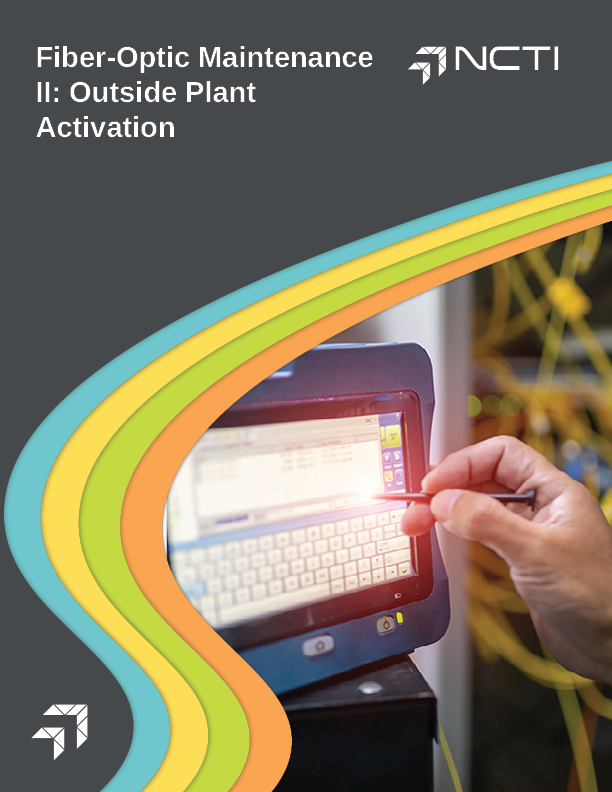
The NCTI® Fiber-Optic Maintenance II: Outside Plant Activation course builds on foundational skills by concentrating on activating, testing, and troubleshooting live fiber-optic networks in the outside plant (OSP). OSP activation is a critical phase in fiber-optic network deployments. It involves testing, verification, and final preparation of the network segment, typically from the central office to the end-user, before placing it into live service. This process ensures the network meets performance standards and can carry data reliably and efficiently.
This course provides a deeper understanding of optical time domain reflectometer (OTDR) configuration and operation, including trace interpretation, signature analysis, and event documentation. Students will explore industry standards for acceptance testing, proper splice evaluation, and advanced troubleshooting techniques. They learn to adjust OTDR settings like pulse width, range, and refractive index to match the network under test. Reading and analyzing OTDR traces helps identify reflective events, poor splices, connector issues, or bends in the fiber that could compromise performance. Verifying that all fiber connections are clean and properly installed is equally important. Upon completion, participants have the practical skills and knowledge to evaluate splice quality, measure optical return loss, and use documentation to verify that networks meet performance specifications.

- Price: $415.00
- Seat time: 4h
- Course number: eb0688_01_JN
- Dynamic language translation available
- Category: Technical and Safety
The estimated completion time for this course is 8 hours. The maximum allotted time is four months from enrollment.
Course Objectives
Identify best practices for safely handling optical fibers and OTDRs, including proper connector cleaning techniques.
Describe OTDR connection methods and explain the role of TIA standards in ensuring accurate fiber-optic measurements.
Identify and describe the key areas of OTDR configuration, including refractive index, wavelength, pulse width, range, dead zones, and event settings.
Explain how to analyze OTDR traces to filter out noise and accurately measure signal loss.
Explain how to use an OTDR for acceptance testing, including measuring splice loss, connector loss, reflectance, and optical return loss.
Describe how OTDRs capture and store trace data for fibers, splices, and spans.
Identify and explain common OTDR trace signatures, including reflective, nonreflective, gain, roll-off, and ghost signatures, and their causes.

Describe how fiber-optic splitters function and how they appear on OTDR traces.
Describe standard OTDR configuration settings and explain how to perform fiber acceptance testing, including identifying and documenting splices.
Explain when and how to test splices and take corrective actions using OTDR results.
Describe OTDR connection methods and explain the role of TIA standards in ensuring accurate fiber-optic measurements.
Identify and describe the key areas of OTDR configuration, including refractive index, wavelength, pulse width, range, dead zones, and event settings.
Explain how to analyze OTDR traces to filter out noise and accurately measure signal loss.
Explain how to use an OTDR for acceptance testing, including measuring splice loss, connector loss, reflectance, and optical return loss.
Describe how OTDRs capture and store trace data for fibers, splices, and spans.
Identify and explain common OTDR trace signatures, including reflective, nonreflective, gain, roll-off, and ghost signatures, and their causes.
Describe how fiber-optic splitters function and how they appear on OTDR traces.

Describe standard OTDR configuration settings and explain how to perform fiber acceptance testing, including identifying and documenting splices.
Explain when and how to test splices and take corrective actions using OTDR results.
Course Benefits
earn two hours of college credit
receive credit toward NCTI Master Technician certification
receive an industry-recognized NCTI certificate of graduation
receive credit toward NCTI Master Technician certification
receive an industry-recognized NCTI certificate of graduation
Share this page: